Showing posts with label Animals. Show all posts

12/25/2011

Dimetrodon

0 nhận xét
Dimetrodon - ancestor of the mammals belonged to the family called Pelycosaurs, which had both mammal and reptile characteristics. Dimetrodon preceded the earliest dinosaurs by more than 40 million years but physically it looked a lot like one. It is often referred to as mammal-like reptile, based on characteristics of the skull and dentition. Dimetrodon was a dominant carnivore, the largest one of the Permian period. It was a predacious reptile that was on the top of the food chain during the early Permian.
This pelycosaur possessed a spectacular sail on its back, supported by long, bony spines, each of which grew out of a separate spinal vertebra. The sail was probably an early experiment in controlling body temperature. It is believed that the sail absorbed the heat of the sun and warmed the blood and body. It warmed up early after sunrise and cooled off more efficiently during the heat of the day. It may have also been used for mating and dominance rituals and making it look much larger than it was to predators. Dimetrodon had a large skull with two types of teeth (sharp canines and shearing teeth). It was probably quite slow because it walked on four side-sprawling legs.
Dimetrodon is one of the more recognized of the early reptiles..
TIME - 280 - 260 MYA, Early Permian period.RANGE - Russia, E. Europe. USA Texas, Oklahoma.DIET - Smaller reptiles and other small vertebrates.SIZE - Up to 6ft (2m) long.

12/20/2011

The American Goldfinch

0 nhận xét

The American Goldfinch is the state bird of Washington. It is common throughout the lowlands of Washington, often coming to bird feeders. The male in breeding plumage is bright yellow with a black forehead, wings, and tail. He has one white wing-bar on each wing and white on his tail. Outside of the breeding season, the male is drab brown with hints of yellow and white wing-bars. In both breeding and non-breeding plumage, he has white undertail coverts contrasting with the yellow undertail coverts of the Lesser Goldfinch. The female in breeding plumage is yellowish-gray-brown on top and varies in color from bright yellow to dull yellow underneath. She has two light wing-bars on each wing and a light-colored bill. Her tail is black with white outer tips. Outside of the breeding season, she is gray above and below, and has less distinct wing-bars and a darker bill.

Habitat

American Goldfinches can generally be found in brushy and weedy habitats at the edges of fields, rivers, and hedgerows, especially when thistle is present. Suburban gardens, poplar plantations, orchards, and other brushy areas with scattered deciduous trees are commonly used.

Behavior

Flocks are common outside of the breeding season, and American Goldfinches often flock with redpolls and Pine Siskins. They are active foragers, and climb about nimbly when foraging, often hanging from seed-heads and other objects. Like many finches, American Goldfinches have an undulating flight. They often give call notes on the upward strokes

Diet

Small seeds, especially thistle, make up the majority of the American Goldfinch's diet. In the summer, they eat some insects, especially aphids, but seeds dominate their diet. They feed regurgitated seeds to their young.

Nesting

American Goldfinches breed later in the summer than most songbirds. Their breeding is timed to coincide with the peak abundance of thistle seed. They often nest in loose colonies. The nest is located in an upright fork of a shrub, tree, or occasionally a dense weed. The female builds a tightly woven, compact cup of plant fibers and spider webs and lines it with thistle-down. The female incubates 4 to 6 eggs for 12 to 14 days. The male brings her food while she incubates, and while she broods the young for the first few days after they hatch. After that, both parents bring food to the young. The young leave the nest after 12 to 17 days, but the parents continue to feed the young for a few weeks. American Goldfinches generally raise one or two broods each year.

12/13/2011

Japanese Macaque

0 nhận xét
The troop consists of seven monkeys. One adult male, Flash, and six females including Isabelle, Yuki, Hana, Ynez, Iris and Erin. Their ages range from 25 years to the newborn. You are born into your social class. If you have a higher standing it is likely that you will get the most grooming and will eat before the others.Rankings are not stable, and can change depending on the whims of the adult male, Flash. He has the final say as the dominant male and changes may occur after the breeding season.
  
Found in the wild: Japanese macaques are the northernmost of all non-human primates and can live up to elevations of 9,600 feet above sea level. They are found in Honshu, Japan.

See Them at the Central Park Zoo: This troop of primates lives on an island in the center of the Temperate Zone, just across from the Red panda exhibit.

Description: They are Old World monkeys. Individuals have brown-gray fur, a red face, hands and bottom, and a short tail. 

Zeppy the young snow monkey
Baby Zeppy, at seven months old
Zoo Snow Monkey Habitat: A large island surrounded by water. The habitat includes winter hot tubs, that reach the same temperature as the Japanese Macaques body temperature - 104 degrees, for their bathing pleasure. You will also see two black necked swans and will find freeloading Mallard Ducks, raising their ducklings seasonally. 

What do they eat:  In the wild, they will feed on seeds, roots, buds, fruit, invertebrates, berries, leaves, birds eggs, fungi, bark and cereals. Japanese macaques are omnivorous, which means they will eat just about anything- meat or vegetation. At the Central Park Zoo, the troop is fed yams, oranges, apples, green beans, mixed greens, peanuts, and monkey chow.

Life span: 30 years

Threats: Not threatened.

Fun Facts: They live in parts of Japan where it snows. They are the only animal other than humans and raccoons,  who wash their food before they eat it. These are the monkeys you may have seen that find hot springs and spend a lot of time in the winter sitting in the warm water. These monkeys are thought to be the inspiration behind the saying 'see no evil, hear no evil and speak no evil'.

Giant Isopods

0 nhận xét

Giant Isopods are just like some kind of little insects (see picture below), but only in a bigger format. These creatures are crustaceans (a mix between a crab and a shrimp). The Giant Isopod also called Bathynomus giganteus is one of the nine species of the genus Bathynomus. That live in the deep and cold waters of the Atlantic ocean. The Giant Isopod isn't a very lucrative business for fishing industries, because they are hard to catch and when they're brought to the surface they have already been scavenged by other fishes. However in Taiwan where they live much closer in shallow waters they're served in restaurants.

The Giant Isopod can reach a length between 19 cm and 37 cm with a maximum weight of 1.7 kg which isn't so great to be called gigantic, but if we compare these with other normal Isopods, then they are just enormous. The Giant Ispod has a kind of shield on his back with two antennas close to its head. It has 7 pair of legs also called (pereiopods) and one pair of these legs has as function to bring food to its jaws.

Giant Isopod
You see the resembles between the Giant Isopod?

Giant Isopods are deep sea creatures that scavenge at depths of 170m to depths or even 2200 meters. However they prefer to stay at middle depths of 300m to 700m. They love to scavenge dead whales, fish and even squids. It isn't only a scavenger, if its spots a sea cucumber, spunge or another little creature, then he won't hesitate and eat this creature. Living on these depths isn't a paradise. Therefore they could stay for more then eight weeks without any food. The deeper we go the bigger that these Giant Isopods are. Giant Isopods are living fossils, they haven't evolved for over 130 million years.

Giant Isopod

Giant Isopods lay eggs, the mature female develops a marsupium (brood punch) when she becomes  sexually active. The eggs that have been fertilized by the male Isopod will be stored in the marsupium for an unknown time and when the eggs hatch, then the miniature Isopods emerge from the marsupium as little clones.

Did you know that the eggs of the giant Isopod are the biggest ones of all the invertebrates?

12/12/2011

Pelican Eel

0 nhận xét

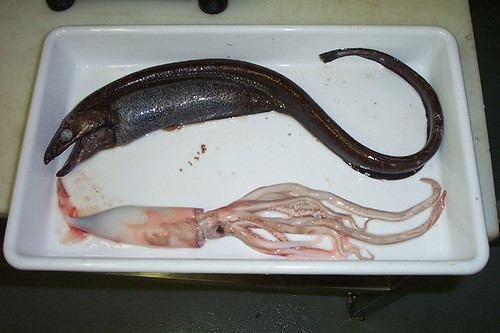
It is almost the end of the week and so far we have talked about birds, mammals and reptiles. I figured this would be a good time to head to the sea and look at an unusual animal that is hardly ever seen by humans. So grab your diving gear and a little bit of courage because we are going to the deep, dark depths of the ocean!
The Pelican Eel is related to the true eels (the ones that we probably familiar with), however, these deep sea eels have some major differences. Most notably has to be the size of this particular eels mouth. The pelican eel has a very large, hinged mouth that is capable of consuming fish much larger than itself. You can see the size of the mouth in the picture above. Actually, this eel received the “Pelican” portion of its name since the lower job resembles the pouch-like beak of a pelican. The most bizarre thing about their mouth is the fact that the pelican eel mostly feeds on small crustaceans. As a matter of fact, they have tiny teeth which are not consistent with animals which feed primarily on fish.
The other interesting feature of this eel is located at the other end of their body. The very tip of their tail happens to be a very complex organ with several tentacles. The cool thing about this organ is the fact that it will glow pink. Scientists presume this feature is to attract fish into the area so it can chomp away at them with their extremely over-sized mouth. Again, this is an odd behaviour for an animal that is suppose to feed on small crustaceans. I am starting to think there is something “fishy” about our understanding of this eel. It just doesn’t make sense to me why they have evolved a large mouth, an attractive tail yet have small teeth and are known to feed on small creatures. Maybe they are in the process of changing for whatever reason? Whatever their story is at least it is an interesting one for all of us to read about.
That just about does it for today’s deep sea adventure. I am glad everyone made the trip and had a safe adventure. See all of you tomorrow!

12/08/2011

Antarctic Krill

0 nhận xét

Krill is a general term used to describe about 85 species of free-swimming, open-ocean crustaceans known as euphausiids.

Scientific name

Euphausia superba

Physical description

With their large black eyes, krill are mostly transparent, although their shells have a bright red tinge from small pigment spots. Their digestive system is usually visible and this is often a vivid green from the pigment of microscopic plants they have eaten. Adult Antarctic krill are approximately six centimetres in length and weigh over a gram.

Distribution and Abundance

Antarctic krill are one of the most abundant and successful animal species on Earth. Scientists estimate there are about 500 million tonnes of Antarctic krill in the Southern Ocean. The biomass of this one species may be the largest of any multi-cellular animal species on the planet.
As krill come to resemble adults they begin to aggregate into huge schools or swarms, sometimes stretching for kilometres in every direction, with many thousands of krill packed into each cubic metre of water, turning the water red or orange.
Most of the time the schools stay deep in the water during daylight hours and only rise to the surface at night. It is not known why swarms are occasionally seen at the surface during broad daylight.

Fishery

Commercial krill fishing began in the early 1970s and the prospect of a free-for-all fishery for Antarctic krill led to the signing of a unique fishing treaty in 1981. The Convention on the Conservation of Antarctic Marine Living Resources is designed to protect the Antarctic ecosystem from the consequences of rapidly expanding fisheries, and to aid recovery of the great whales and some of the overexploited species of fish.
The fishery is managed through an international body (CCAMLR) which sets limits on the krill catch taking into account the needs of other elements of the ecosystem.
Scientists at the Australian Antarctic Division study krill to provide a better understanding of krill life cycles so that the fishery can be better managed.

Breeding

Female Antarctic krill lay up to 10,000 eggs at a time, sometimes several times a season.

Diet and Feeding

Antarctic krill are mainly herbivorous, feeding mostly on the phytoplankton (microscopic suspended plants) of the Southern Ocean and, to a lesser extent, planktonic animals (zooplankton).
In winter, they have to use other food sources such as the algae which grows on the underside of the pack ice, detritus on the sea-floor or the other animals in the water. Krill can survive for long periods (up to 200 days) without food and can shrink in length as they starve.
Most of the larger Antarctic animals, the seals, whales, seabirds, fish and squid, depend directly or indirectly on Antarctic krill.

Atlantic Bluefin Tuna

0 nhận xét

Description & Behavior

Atlantic bluefin tuna, Thunnus thynnus (Linnaeus, 1758), aka blue fin tunas, blue-fin tunny, bluefin tunas, horse mackerels, northern bluefin tunas, and squid hounds, are regarded as one of the most highly evolved fish species and one of the most prized fish in danger of overfishing. Tuna, originating from the Greek word meaning "to rush," usually swim at speeds of 1.5-4 external knots, can maintain 8 externalknots for some time, and can break 20 external knots for short periods. These are one of the most magnificent fishes in the sea. One fish can sell for hundreds of thousands of dollars. A 342 external kg tuna sold at Tokyo's Tsukiji fish market for 32.49 million yen ($396,700 US dollars), the highest price for a single fish since record-keeping began in 1999, that's 95,000 yen ($1,157) per kg!
The Atlantic bluefin tuna is the largest member of the Scombridae Family (albacores, bonitos, mackerels, tunas). It is one of the largest bony fishes and can reach lengths of up to 3 external m, although they are more commonly found from 0.5-2 external m in length. Adult weights range from 136-680 external kg, although the upper weight range is rare, especially now. They can dive as deep as 914 external m, and are known to swim long distances as they are a highly migratory species.
Atlantic bluefins are dark blue to black on their dorsal (upper) surface and silvery ventrally (underneath). The bluefin is known for their finlets that run down their dorsal and ventral sides toward their anal fin. There are 12-14 spines in their first dorsal fin and 13-15 rays in their second dorsal fin. Their anal fin has 11-15 rays. The average lifespan of bluefin tunas is 15-30 years.
Atlantic bluefin are homeothermic ("warm-blooded") and are therefore able to thermoregulate external keeping their body temperatures higher than the surrounding water, which is why they are so well adapted to colder waters.

World Range & Habitat

Atlantic bluefin live in subtropical and temperate waters of the North Atlantic Ocean, the Mediterranean, and Black Seas. Bluefin are highly migratory and limited numbers of individuals may cross the Atlantic in as little as 60 days and are widely distributed throughout the Atlantic and can be found from Newfoundland all the way to the coast of Brazil. They range in the eastern Atlantic as far north as Norway and down to northern West Africa. Bluefin tagged in the Bahamas have been captured in Norway as well as off the coast of Brazil. Bluefin in the South Atlantic belong to a distinct southern population, with known spawning areas south of Java, Indonesia. The bluefin is a pelagic external, schooling fish. They tend to group together according to size.

Feeding Behavior (Ecology)

Atlantic bluefin tuna consume smaller fishes such as mackerel, herring, whiting, flying fish, and mullet as well as squid, eels, and crustaceans.

Life History

Although Atlantic bluefin are widely distributed and migrate thousands of kilometers, there are two confirmed spawning locations—the Gulf of Mexico in the western Atlantic and the Mediterranean Sea in the eastern Atlantic. Although many ecological and environmental variables undoubtedly affect both the location and productivity of spawning in these two areas, relatively little is known concerning why bluefin spawn where they do.
Spawning in the Gulf of Mexico occurs between mid-April and mid-June when females, which mature around age 8, release approximately 30 million eggs each. The highest density of bluefin larvae, the primary indicator of spawning, occurs in the northern Gulf of Mexico with lesser larval concentrations appearing off the Texas coast and in the Straits of Florida.
In the eastern Atlantic, spawning occurs exclusively in the Mediterranean and Adriatic Seas from June through August, with the highest larvae concentrations appearing around southern Italy. Although some fishery biologists believe that eastern Atlantic bluefin reach sexual maturity several years earlier than western Atlantic bluefin (possibly as young as ages 4-5), this understanding has been criticized. Juvenile Bluefin Tuna Found To Dive To Depths Of More Than 1,000 Meters external

Conservation Status & Comments(in need of updating, is very likely threatened):

"A taxon is Data Deficient when there is inadequate information to make a direct, or indirect, assessment of its risk of extinction based on its distribution and/or population status. A taxon in this category may be well studied, and its biology well known, but appropriate data on abundance and/or distribution is lacking. Data Deficient is therefore not a category of threat or Lower Risk. Listing of taxa in this category indicates that more information is required and acknowledges the possibility that future research will show that threatened classification is appropriate. It is important to make positive use of whatever data are available. In many cases great care should be exercised in choosing between DD and threatened status. If the range of a taxon is suspected to be relatively circumscribed, if a considerable period of time has elapsed since the last record of the taxon, threatened status may well be justified."
International sport fishing for "giant" bluefin originated about 100 years ago, becoming popular domestically in the early 1900s. The Sharp Cup in Nova Scotia was a distinguished international bluefin tournament held from the early 1930s through the 1960s, with a peak landing of 1,760 fish in 1949. Many other tournaments existed throughout the Northeast United States until the mid-1960s, when giant bluefin abundance near tournament sites appeared to decline. Although studies have been inconclusive regarding these changes, suspected causes include changes in water temperature, oceanic currents, availability of food, and overfishing external.
Prior to 1970, sport fishing was exclusively recreational, as giant bluefin tuna had a commercial value of only $.05 per pound. Giant trophy tuna that were not kept for personal display or consumption were sold to cat and dog food producers. With the development of the Japanese specialty market in the early 1970s, giant bluefin tuna suddenly represented big money to traditional sport fishermen. Perspectives on the fishery shifted, and the recreational character of the fishery was altered by economic opportunity. A giant 225 externalkg trophy fish was, by the late 1970s, a highly valued Japanese delicacy. Participation exploded and the giant bluefin fishery capitalized quickly.
Now many "recreational anglers" also obtain commercial permits, so that virtually all giant bluefin tuna currently caught are marketed commercially, except for a small scale catch-and-release sport fishery in the Bahamas. A substantial charter- or party-boat fishery for small bluefin tuna also exists from North Carolina to Massachusetts. Estimated at more than 15,000 recreational anglers annually, this is the only U.S. fishery allowed to catch bluefin smaller than the minimum commercial size (1.78 external m from the tip of a fish's snout to the fork of its tail).

12/06/2011

Siamang

0 nhận xét

PHYSICAL CHARACTERISTICS:

The Siamang is a gibbon and like the latter, it is an ape, not a monkey. The chief characteristics distinguishing apes from monkeys are the absence of a tail, their more or less upright posture and the high development of their brain. (Gorillas, chimpanzees and orangutans are also apes.)
The Siamang is always black in color, with reddish-brown eyebrows. It differs from other gibbons in that it has a webbing between the second and third toe. The largest of the gibbon family, Siamangs are also the best at walking on two legs.
Like other gibbons, they have tough, horny pads on their buttocks known as ischial callosities. Since Siamangs and Gibbons build no sleeping nest, the pads help them spend a comfortable night seated on tree branches safe from predators.
Male and female are similar in size, growing to 30-35 inches in length and weighing approximately 23 pounds.

DISTRIBUTION and HABITAT:

Siamangs range through southeastern Asia and are found in some numbers in the Malay Peninsula and Sumatra.

BEHAVIOR:

Click to enlarge photo.
Along with other gibbons, the Siamangs are the top trapeze artists of the animal world. They leap with confidence across formidable gaps between branches, launching themselves 30-50 feet, using their hands as hooks. This mode of locomotion is called brachiation. While their arms are used for travel, their feet are used to carry objects. When walking, Siamangs will hold their arms above their heads for balance.
Siamangs live in family groups lead by a dominant male. They are protective of one another and sociable among themselves, huddling together in groups of two or three when they sleep.
The call of the Siamang excels that of other gibbons because of the animal's sound-amplifying throat sac. The female emits a series of barks alternated with booms resonated in the vocal pouch, which she blows up like a balloon. The mate's higher scream is usually uttered at each of the two accelerations of the female, and their combined "song" rises in pitch to end with the thunderous pouch boom of the male. It is quite a display of territory and power and can be heard for a considerable distance.

DIET:

Siamangs eat fruit, leaves, insects, nuts, small animals, birds and bird's eggs. In the zoo they are fed fruit, vegetables and monkey chow.
Click to enlarge photo.

REPRODUCTION and GROWTH:

Siamangs bear one offspring after a seven- month gestation period. At birth, the young are naked, and for the first few months, the baby clings to the mother's abdomen. She, in turn, keeps her legs partially raised to provide warmth and support. By the age of two, the baby is independent but still very much a part of the family.
Sexual maturity is reached at about seven years of age.  In the wild they live from 25 to 30 years.
ENDANGERED STATUS:
Like other gibbons, the Siamang is declining in numbers as man enters its forested territory, often killing the mothers in capturing the young for a lucrative pet market.

Arctic Fox

0 nhận xét

The Arctic fox (Alopex lagopus) makes its home in small burrows in frost-free ground, often in low mounds, or in rock piles. Because the Arctic fox is a scavenger it can usually find food to eat. Sometimes the fox will follow Polar bears or other predators and feed off the remains they leave behind.


The Arctic fox is about 10 -16 inches long and weighs about 6-12 pounds. It is about the size of an ordinary domesticated house cat. It has short legs a long bushy tail that it uses as insulation by wrapping it around itself when sleeping. Its long hair is white in the winter, and "blue" or gray in the summer. Its head has a stubby muzzle, small ears, and large eyes. Its feet are lined with fur, which helps it conserve heat. The Arctic fox has adapted a stealthy movement due to its predatory nature.

Both male and female mature sexually at one year of age. The mating season is May-February and the gestation period for a pregnant female is 52 days. The number of pups born can range between 6-19, and the newborns weigh approximately 2 ounces. Whelps are helpless and blind when first born. They nurse until they can eat solid food. Both parents care for the pups. The mother raises the young while the father hunts for lemmings and other food. They start to eat solids after 6 weeks and leave the den after 14-15 weeks. The whelp is usually dependent on its parent from summer to fall. Mortality rates for young foxes is very high. An average life span for the arctic fox is around three years.
The Arctic fox is a solitary animal. Arctic foxes usually live to 15 years of age. It is an omnivore (one who eats both plants and animals). A typical diet of this fox consists of birds, eggs, small mammals and fish. It will also eat berries, seaweed, insects and larvae, when other prey is scarce. The Arctic fox is a predator to lemmings (one of it's favorite foods) and voles, among other creatures. The population cycles of lemmings and voles are largely dependent on the arctic fox. The fox is prey to wolves, polar bears and golden eagles. Because it is a scavenger, it keeps the environment clean by eating dead animals and keeping the rodent population down. The Arctic fox is a diurnal creature.
The Arctic fox has adapted to its environment by growing long fur that changes color with the season for camouflage. It tends to eat whatever is available. It s movements are stealthy due to lack of cover on the tundra. Its legs, ears, and muzzle are short to conserve heat, and uses its tail like a muffler when cold.
The Arctic fox is not endangered world wide and it is estimated that there are several thousand arctic foxes left in the wild. Two arctic fox populations are endangered, however. One in Russia has been reduced to around 90 animals because of a mange caused by ear ticks introduced by dogs. The second in Fennoscandia (Norway, Sweden, Finland, and Kola Peninsula) was caused by over hunting around the turn of the century. The total number of breeding pairs there is about 140.

12/04/2011

Scheltopusik

0 nhận xét

Although it might look like a snake, the scheltopusik is a legless lizard, and is sometimes known by its other name, the European glass lizard. The lizard grows to 1.35 metres and is usually tan coloured with a paler head and underbelly. It has two tiny legs, or leg stubs near its cloaca at the base of the tail.

Habitat:

European mainland to Central Asia. The scheltopusik prefers light woods, scrubby vegetation and rocky outcrops. Although it favours dry areas, it will come out after rain to hunt for snails and slugs.

Diet:

Snails, slugs, insects, eggs and occasionally very small mammals and birds.

Reproduction:

Females lay about 8 eggs some 10 weeks after mating. The eggs are often hidden in a crevice and guarded by the female. After about 50 days the young hatch and are 15 cm long.

11/16/2011

Pacu fish

0 nhận xét


Pacu fish, cousins to the piranha and known as "frugivores," have human-like teeth that can crack nuts and fruits. Pacu and piranha – both native from South – have similar teeth, although the difference is jaw alignments; piranha have pointed, razor-sharp teeth in a pronounced underbite, whereas pacu have squarer, straighter teeth in a less severe underbite. Pacu, a safer alternative to meat-eating piranhas, is a popular aquarium fish world-wide.

11/11/2011

Animals cute

0 nhận xét
Baby Tapir:
The male baby Malayan tapir called Kamal, whose name means ‘perfection’ were born at the Edinburgh Zoo.


Baby Fennex foxes:
These adorable creatures were born at the Everland Zoo in Seoul, Korea:


And these are from Germany's Zoo Darmstadt:


© Joachim S. Müller


© Joachim S. Müller

Rare white otter cubs:
These adorable rare white otter cubs were born at the
Blue Planet Aquarium:


Baby Aardvark:
This baby Aardvark was born at the UK's
Colchester Zoo:


And this one at the Omaha's Henry Doorly Zoo:


Baby Tenrecs:

These baby Tenrecs were born at the
WCS Bronx Zoo:


© Julie Larsen Maher / WCS Bronx Zoo


© Julie Larsen Maher / WCS Bronx Zoo


© Julie Larsen Maher / WCS Bronx Zoo

Baby Mouse Deer:
This tiny bay mouse deer was born at the
Paignton Zoo:


Baby Sloths:
These photos of mother sloth Alba and her daughter, were taken at the
Singapore Zoo:


© Shirley Ng


© Shirley Ng


© Shirley Ng

The Aviarios Sloth Sanctuary cares for injured and orphaned sloths in Costa Rica. They also lead sloth education efforts to improve the plight of wild sloths. From time to time, they even have a captive birth, including this baby three-toed sloth called a bradypus or pale-throated sloth:


Baby Wombat:
This baby Wombat was born at Australia's Toronga Zoo:


Image source


Image source


Image source

Baby Pigmy Hippo:
This baby pigmy hippo was also born at the
Toronga Zoo: