Showing posts with label Fish. Show all posts

12/12/2011

Pelican Eel

0 nhận xét

It is almost the end of the week and so far we have talked about birds, mammals and reptiles. I figured this would be a good time to head to the sea and look at an unusual animal that is hardly ever seen by humans. So grab your diving gear and a little bit of courage because we are going to the deep, dark depths of the ocean!
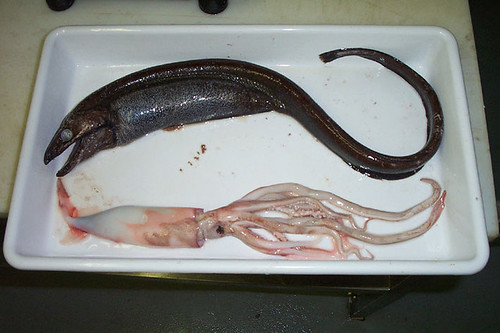
The Pelican Eel is related to the true eels (the ones that we probably familiar with), however, these deep sea eels have some major differences. Most notably has to be the size of this particular eels mouth. The pelican eel has a very large, hinged mouth that is capable of consuming fish much larger than itself. You can see the size of the mouth in the picture above. Actually, this eel received the “Pelican” portion of its name since the lower job resembles the pouch-like beak of a pelican. The most bizarre thing about their mouth is the fact that the pelican eel mostly feeds on small crustaceans. As a matter of fact, they have tiny teeth which are not consistent with animals which feed primarily on fish.
The other interesting feature of this eel is located at the other end of their body. The very tip of their tail happens to be a very complex organ with several tentacles. The cool thing about this organ is the fact that it will glow pink. Scientists presume this feature is to attract fish into the area so it can chomp away at them with their extremely over-sized mouth. Again, this is an odd behaviour for an animal that is suppose to feed on small crustaceans. I am starting to think there is something “fishy” about our understanding of this eel. It just doesn’t make sense to me why they have evolved a large mouth, an attractive tail yet have small teeth and are known to feed on small creatures. Maybe they are in the process of changing for whatever reason? Whatever their story is at least it is an interesting one for all of us to read about.
That just about does it for today’s deep sea adventure. I am glad everyone made the trip and had a safe adventure. See all of you tomorrow!

12/08/2011

Antarctic Krill

0 nhận xét

Krill is a general term used to describe about 85 species of free-swimming, open-ocean crustaceans known as euphausiids.

Scientific name

Euphausia superba

Physical description

With their large black eyes, krill are mostly transparent, although their shells have a bright red tinge from small pigment spots. Their digestive system is usually visible and this is often a vivid green from the pigment of microscopic plants they have eaten. Adult Antarctic krill are approximately six centimetres in length and weigh over a gram.

Distribution and Abundance

Antarctic krill are one of the most abundant and successful animal species on Earth. Scientists estimate there are about 500 million tonnes of Antarctic krill in the Southern Ocean. The biomass of this one species may be the largest of any multi-cellular animal species on the planet.
As krill come to resemble adults they begin to aggregate into huge schools or swarms, sometimes stretching for kilometres in every direction, with many thousands of krill packed into each cubic metre of water, turning the water red or orange.
Most of the time the schools stay deep in the water during daylight hours and only rise to the surface at night. It is not known why swarms are occasionally seen at the surface during broad daylight.

Fishery

Commercial krill fishing began in the early 1970s and the prospect of a free-for-all fishery for Antarctic krill led to the signing of a unique fishing treaty in 1981. The Convention on the Conservation of Antarctic Marine Living Resources is designed to protect the Antarctic ecosystem from the consequences of rapidly expanding fisheries, and to aid recovery of the great whales and some of the overexploited species of fish.
The fishery is managed through an international body (CCAMLR) which sets limits on the krill catch taking into account the needs of other elements of the ecosystem.
Scientists at the Australian Antarctic Division study krill to provide a better understanding of krill life cycles so that the fishery can be better managed.

Breeding

Female Antarctic krill lay up to 10,000 eggs at a time, sometimes several times a season.

Diet and Feeding

Antarctic krill are mainly herbivorous, feeding mostly on the phytoplankton (microscopic suspended plants) of the Southern Ocean and, to a lesser extent, planktonic animals (zooplankton).
In winter, they have to use other food sources such as the algae which grows on the underside of the pack ice, detritus on the sea-floor or the other animals in the water. Krill can survive for long periods (up to 200 days) without food and can shrink in length as they starve.
Most of the larger Antarctic animals, the seals, whales, seabirds, fish and squid, depend directly or indirectly on Antarctic krill.

Atlantic Bluefin Tuna

0 nhận xét

Description & Behavior

Atlantic bluefin tuna, Thunnus thynnus (Linnaeus, 1758), aka blue fin tunas, blue-fin tunny, bluefin tunas, horse mackerels, northern bluefin tunas, and squid hounds, are regarded as one of the most highly evolved fish species and one of the most prized fish in danger of overfishing. Tuna, originating from the Greek word meaning "to rush," usually swim at speeds of 1.5-4 external knots, can maintain 8 externalknots for some time, and can break 20 external knots for short periods. These are one of the most magnificent fishes in the sea. One fish can sell for hundreds of thousands of dollars. A 342 external kg tuna sold at Tokyo's Tsukiji fish market for 32.49 million yen ($396,700 US dollars), the highest price for a single fish since record-keeping began in 1999, that's 95,000 yen ($1,157) per kg!
The Atlantic bluefin tuna is the largest member of the Scombridae Family (albacores, bonitos, mackerels, tunas). It is one of the largest bony fishes and can reach lengths of up to 3 external m, although they are more commonly found from 0.5-2 external m in length. Adult weights range from 136-680 external kg, although the upper weight range is rare, especially now. They can dive as deep as 914 external m, and are known to swim long distances as they are a highly migratory species.
Atlantic bluefins are dark blue to black on their dorsal (upper) surface and silvery ventrally (underneath). The bluefin is known for their finlets that run down their dorsal and ventral sides toward their anal fin. There are 12-14 spines in their first dorsal fin and 13-15 rays in their second dorsal fin. Their anal fin has 11-15 rays. The average lifespan of bluefin tunas is 15-30 years.
Atlantic bluefin are homeothermic ("warm-blooded") and are therefore able to thermoregulate external keeping their body temperatures higher than the surrounding water, which is why they are so well adapted to colder waters.

World Range & Habitat

Atlantic bluefin live in subtropical and temperate waters of the North Atlantic Ocean, the Mediterranean, and Black Seas. Bluefin are highly migratory and limited numbers of individuals may cross the Atlantic in as little as 60 days and are widely distributed throughout the Atlantic and can be found from Newfoundland all the way to the coast of Brazil. They range in the eastern Atlantic as far north as Norway and down to northern West Africa. Bluefin tagged in the Bahamas have been captured in Norway as well as off the coast of Brazil. Bluefin in the South Atlantic belong to a distinct southern population, with known spawning areas south of Java, Indonesia. The bluefin is a pelagic external, schooling fish. They tend to group together according to size.

Feeding Behavior (Ecology)

Atlantic bluefin tuna consume smaller fishes such as mackerel, herring, whiting, flying fish, and mullet as well as squid, eels, and crustaceans.

Life History

Although Atlantic bluefin are widely distributed and migrate thousands of kilometers, there are two confirmed spawning locations—the Gulf of Mexico in the western Atlantic and the Mediterranean Sea in the eastern Atlantic. Although many ecological and environmental variables undoubtedly affect both the location and productivity of spawning in these two areas, relatively little is known concerning why bluefin spawn where they do.
Spawning in the Gulf of Mexico occurs between mid-April and mid-June when females, which mature around age 8, release approximately 30 million eggs each. The highest density of bluefin larvae, the primary indicator of spawning, occurs in the northern Gulf of Mexico with lesser larval concentrations appearing off the Texas coast and in the Straits of Florida.
In the eastern Atlantic, spawning occurs exclusively in the Mediterranean and Adriatic Seas from June through August, with the highest larvae concentrations appearing around southern Italy. Although some fishery biologists believe that eastern Atlantic bluefin reach sexual maturity several years earlier than western Atlantic bluefin (possibly as young as ages 4-5), this understanding has been criticized. Juvenile Bluefin Tuna Found To Dive To Depths Of More Than 1,000 Meters external

Conservation Status & Comments(in need of updating, is very likely threatened):

"A taxon is Data Deficient when there is inadequate information to make a direct, or indirect, assessment of its risk of extinction based on its distribution and/or population status. A taxon in this category may be well studied, and its biology well known, but appropriate data on abundance and/or distribution is lacking. Data Deficient is therefore not a category of threat or Lower Risk. Listing of taxa in this category indicates that more information is required and acknowledges the possibility that future research will show that threatened classification is appropriate. It is important to make positive use of whatever data are available. In many cases great care should be exercised in choosing between DD and threatened status. If the range of a taxon is suspected to be relatively circumscribed, if a considerable period of time has elapsed since the last record of the taxon, threatened status may well be justified."
International sport fishing for "giant" bluefin originated about 100 years ago, becoming popular domestically in the early 1900s. The Sharp Cup in Nova Scotia was a distinguished international bluefin tournament held from the early 1930s through the 1960s, with a peak landing of 1,760 fish in 1949. Many other tournaments existed throughout the Northeast United States until the mid-1960s, when giant bluefin abundance near tournament sites appeared to decline. Although studies have been inconclusive regarding these changes, suspected causes include changes in water temperature, oceanic currents, availability of food, and overfishing external.
Prior to 1970, sport fishing was exclusively recreational, as giant bluefin tuna had a commercial value of only $.05 per pound. Giant trophy tuna that were not kept for personal display or consumption were sold to cat and dog food producers. With the development of the Japanese specialty market in the early 1970s, giant bluefin tuna suddenly represented big money to traditional sport fishermen. Perspectives on the fishery shifted, and the recreational character of the fishery was altered by economic opportunity. A giant 225 externalkg trophy fish was, by the late 1970s, a highly valued Japanese delicacy. Participation exploded and the giant bluefin fishery capitalized quickly.
Now many "recreational anglers" also obtain commercial permits, so that virtually all giant bluefin tuna currently caught are marketed commercially, except for a small scale catch-and-release sport fishery in the Bahamas. A substantial charter- or party-boat fishery for small bluefin tuna also exists from North Carolina to Massachusetts. Estimated at more than 15,000 recreational anglers annually, this is the only U.S. fishery allowed to catch bluefin smaller than the minimum commercial size (1.78 external m from the tip of a fish's snout to the fork of its tail).

11/05/2011

Squid Worm

0 nhận xét
Two miles deep, down in the waters between Indonesia and the Philippines, there lives and animal so unusual that on first glance, no one knew what it was. Was it a squid? Was it a worm? What is this thing? After a few years of study, we now know. It is, in fact, a Squid Worm, a member of the earthworm and tube worm filled Annelid phylum.

Squid Worms (Teuthidodrilus samae) are interesting because they are remarkably abundant, and are relatively large for a deep sea creature. They measure about four inches in length. The name comes from the ten tentacles that protrude outward from the head. The Squid Worm also has iridescent bristles that run down the length of their body, aiding in movement. They feed off of plankton and small floating debris.

Another notable fact about the Squid Worm is that it might be a transitional species; and animal that stradles the line between species that reside on the sea floor, and those that swim openly. Such transitional species are important in understanding evolutionary history.

Beluga Whale

0 nhận xét

Beluga or "white whales" are not born white. They are grey at birth and get lighter and lighter until at about age six they are completely white. Belugas are one of the three whales that spend all their lives in arctic waters. The other two are the bowhead and the narwhal. Beluga are special among all whales because they can turn their heads. Maybe this is so that they can communicate with each other better! Beluga are very social and make a wide variety of sounds. A group of beluga can be loud! They have been nick-named "sea canaries." Beluga use sound to help them find their prey. They send out a sound which bounces off things in the water and allows them to hear how far away something is. This is called "echolocation." Beluga will work together using this and other techniques to herd fish into shallow water. It has also been reported by native people that beluga whales help each other give birth! They use many subtle forms of communication including a wide variety of facial expressions. Unlike some other whales, beluga have good vision.What they don't have is a dorsal fin, earning them the name "delphinapterus" or dolphin-without-a-wing.


19th Century Naturalist
Edward Nelson Recounts:

"In January,  1879, while sledging near the mouth of the Kuskoquim River, a considerable number of White Whales were seen one evening among the broken ice near shore.  They were in an irregular school containing twenty or more individuals.  They are seen sometimes in winter off the Yukon mouth when the ice is driven off shore or broken up.
At Point Hope on July 20, 1881, the females were seen swimming up and down the shore singly, each with two or three males keeping close alongside.  Each female was accompanied by a young of the year, which kept close above its mothers back or just behind her.
At Saint Michaels the first ones seen in spring usually arrive between the 5th and l0th of June soon after the ice moves offshore or leaves the inner bays.  This is the spawning time for the herring which swarm along the shore and the White Whales follow them into all the bays and inlets.  On calm June mornings great schools of these whales, numbering from twenty to over a hundred animals, are frequently seen in the bay at Saint Michaels, and their glistening milk-white color shows handsomely against the dark green water.
About the middle of June the first young are seen.  For the first few weeks after their birth they are very small, and have a great bulging forehead, which extends beyond a vertical line from the end of the jaws.  Their color is a dark livid bluish or dull bluish green, so dark that they look almost black when seen at a distance in the water.  They keep close to their mothers, and the latter swim very carefully, the young usually resting on their backs just beside the thin upward extension of the skin, which appears like a false fin.  During the remainder of the season they are generally distributed along the coast.  The closing of the bays and streams by ice the last of October drives them off shore and south each autumn."
BELUGA WHALE
Beluga Whale

Spotted Garden Eel

0 nhận xét
The spotted garden eel can be found in tropical waters in the Indo-Pacific region from Africa to Japan and Australia. It occurs most commonly on protected sandy bottom slopes that are exposed to current. This species is most often seen in dense colonies of up to several hundred individuals with only about one-quarter of their 16- to 24-inch bodies extending above the surface of the sand. 

This fish uses its pointed tail to burrow into the sandy bottom and then secretes mucus to bind the sand grains along the burrow walls to prevent its collapse. Individuals rarely leave their burrow and even reproduce by leaning over to intertwine with an adjacent mate. 

Megalodon

0 nhận xét
One of the most deadly and dangerous sharks is the Great White, which can grow to lengths of 20 feet. less than two million years go, however, we would've had the Megalodon to deal with. It is perhaps the largest predatory fish ever to exist, sporting lengths of over 50 feet, and a jaw 7 feet wide. Their individual teeth could grow to 7 inches long, and during theRenaissance, fossilized teeth were thought to be the teeth of mythical dragons! It wasn't until the late 17th century that scientists realized they were looking at a really, really big shark. (Teeth are really the only remnant that we have of these beast, as cartilage fossilizes very poorly)

Really, really big shark.

Image from Thinkquest
So what did the Megalodon eat? In short, probably everything. It is estimated they they consumed up to 2,500lbs of food each and every day, which really doesn't seem like all that much when you consider that they have to power a muscular body that weighs over 50tons. They most likely consumed whales of the time, as well as fish, and other sea mammals. Megalodons lived in coastal areas around the world. Basically nothing fed on them.

Image from Karen Carr
No one is 100% sure about why the Megalodon went extinct. They dominated the seas for nearly 20 million years, and then all died out about 1.6 million years ago. Habitat changes and loss of prey may have been the culprits. Some cryptozoologistsbelieve that the Megalodon is still out there, due to unconfirmed sightings and the fact that it's extinction is relatively recent. However, due to the size and thecoastal habitats of the Megalodons, their continued existence is pretty unlikely.

Arapaima

0 nhận xét
The Arapaima (Arapaima gigas) is one of the largest freshwater fish in the world. Measuring up to ten feet long and weighing 400 pounds, it is a true river giant. They are native to the Amazon River, where they and their descendants have been swimming since the Jurassic.

Arapaimas are air-breathers, meaning that they inhale their oxygen through the air rather than through the water. Because of this, they are typically found near the surface of the water, though they are able to hold their breath for 10-20 minutes.

The breeding cycle of the Arapaima is dependent on the seasons. Eggs are laid February-April, when the water is at its lowest, and hatch during the flooding season so that the young fish can thrive and feast on all of the organisms that are churned up. Male Arapaimas take an interesting role in the process, incubating the eggs in his mouth (mouthbrooding).

(Image Source)
Water birds beware! Though the Arapaima mainly eatsfish, they will also gulp up birds that they find on the waters' surface. Surface proximity has caused problems for the Arapaima; it makes them much easier to fish for with nets or harpoons. Their meat, tongue, and scales are collected for food and jewelry. Hunting has been the main reason for their population decline, and they are now listed as Vulnerable.

10/31/2011

most beautiful fish in the world

1 nhận xét
1. Mandarin Fish
http://hermawayne.blogspot.com
There are 2 varieties of this species, namely Mandarinfish standards and Psychedelic Mandarin. The standard usually have a pattern and color better than the Psychedelic. It costs no more than $ 20 perhead, but the problem was the food that is difficult to find.

2. Discus
http://hermawayne.blogspot.com
This fish is a freshwater fish species which may be a freshwater fish of the most beautiful. The price is very expensive, puppies sekitar3 inches in length only between $ 50 - $ 80.

3. Lion Fish
http://hermawayne.blogspot.com
This fish is also called zebrafish. Spine has a venom that is very painful and quite effective.

4. Moorish Idol
http://hermawayne.blogspot.com
This fish is very difficult to be maintained with a standard aquarium, and also the exorbitant price tag thatsoared.

5. Koi
http://hermawayne.blogspot.com
There are many color variations of koi fish (about 100an). Koi can have orange, red, white, golden, orblack. Some koi enthusiasts willing to pay thousands of dollars for a koi only to find that rare koi colorpattern.

6. Flame Angel
http://hermawayne.blogspot.com
This fish has a close relationship with the Coral Beauty. Its just like the Coral Beauty, but nature does not 'seteguh' Coral Beauty.

7. Coral Beauty
http://hermawayne.blogspot.com
This fish is relatively easy to maintain fish in the aquarium and can survive in both habitats.