Showing posts with label travel wonders. Show all posts

4/02/2012

Keeping Medieval Time in Lund (Sweden)

0 nhận xét
The southern Swedish town of Lund buzzes with a bohemian university atmosphere that permeates its medieval streets. Packed into a few streets are an array of museums, a grand cathedral and a fine collection of preserved Swedish buildings from the past.

The spires of the grey monochromatic cathedral (built during Danish rule) tower above the town. The exterior of the cathedral is decorated with an array of dramatic carvings of grotesque animals and birds to help keep the evil spirits at bay.

Standing alone in the cathedral’s crypt is an eerie experience. The floor is covered in tombstones. In limited light, the spirits of its 900 years moodily wander among the thick stone pillars – the crypt seems unchanged since it was built. Two stories emanate from the crypt to add to its mystique. One tells of a proud but tiny archbishop Gunnarsson so chastened by his lack of height that he demanded that his effigy should be tall and dignified.

The other has a more traditional Norse flavour. A giant troll, named Finn, wandering past the site of the cathedral offered to build a church. The payment would be the priest's eyes and heart unless he could guess the troll's name. Alarmingly, the troll was powerful and an adept builder, quickly assembling the cathedral. With only the final pillar to set, the priest lay down in a field in an abject state of panic, fearing a loss of his eyesight, when the tuneful words of a troll-woman included the troll's name. He rushed back to the church and yelled Finn when the troll tried to pull a pillar out of the ground to knock over the cathedral. At that point Finn was turned to stone with his towering figure still in evidence in the crypt with empty eye sockets.

While the story is clearly fanciful (and the figure is likely to be Samson), I love the mix of pagan saga mixed with the history of this fine cathedral.

The interior of the cathedral is extremely plain but has a feeling of grandeur. However the undoubted highlight is a fascinating astronomical clock located near the entrance. Built in 1423 (though hidden in boxes in the cathedral vault for a number of centuries), the extraordinary mechanisms for the time slowly move a variety of dials and wheels that unveil a plethora of astronomical information from phases of the moon, the location of the astrological signs and the position of the sun at sunset.

The bottom of the clock shows a huge wheel, good till 2123 (unlike the Mayans, not everyone is finishing their calendars at 2012!!) that highlight the relevant saint day (with every day appears to be assigned to someone) and the various religious holidays and festivals (including those that vary from year to year). The clock is absorbing with many features being discovered the longer that you spend looking at its detail.

Twice a day the clock celebrates the striking of an hour as trumpeters raise their instruments and play a medieval hymn through the cathedral’s pipe organ while the Three Kings and their servants quickly bow and parade past Mary and a baby Jesus.

Bridge Over the River Kwai (Kanchanaburi, Thailand)

0 nhận xét

Around 100 humid kilometers north of Bangkok is the bridge made famous by the film The Bridge Over the River Kwai. Kanchanaburi is the site of the Burma-Siam Railway Bridge built by prisoners of the Japanese in World War 2 under forced labour conditions. Today’s idyllic tropical setting (and even the movie) belies the appalling privations, random punishments, disease, meagre food and atrocities along with the withering humidity and searing heat suffered by the bridge builders. The toll was so large – over 12,000 prisoners of war and around 90,000 Burmese, Thai, Malay and Indonesian forced labourers lost their lives in construction of the railroad – that it became known as the Death Railway.

An excellent and busy tourist train (on weekends only) takes a scenic three hours aimed more at Thais than foreign visitors stopping near the famous bridge. The train nervously slows a couple of times on its journey to a snail’s pace to traverse old and rickety wooden bridges held up more by divine intervention than any expertise in engineering.

The train stops near the famed bridge where the passengers stroll the steel and wooden structure kept immaculate for all the visitors (only the outer spans are original as most was destroyed by bombing raids). Trains chuff across the bridge at regular intervals while the tourist train continues over the bridge to its terminus at Nam Tok with its scenic waterfall.

The gently running placid river and quiet setting give little feeling of the toil and hardship that went into building this key railway link and the plain dark steel arches lack character. Unsurprisingly, it is not the bridge used in the movie, which was fully shot on location in Sri Lanka!!

Nearby is the slightly disappointing JEATH Museum, its unusual name being an acronym of the various nations involved with the bridge (Japan, England, Australia / America, Thailand and Holland). Run by the local monks, there are some moving pictures, sketches and newspaper clippings shown in a cramped humid dingy bamboo hut to resemble the accommodation of the prisoners. Many of the exhibits are masked in plastic to prevent damage from the moisture and so are difficult to read or view properly in the poor light.

The bridge only became famous with the success of the movie. Ironically, for its grand title, the bridge doesn’t actually cross the Kwai but rather the Mae Klong (klong is canal in Thai). The Mae Klong runs into the confluence of the Khwae Yai and Khwae Noi Rivers (literally the big and little Khwae).

Under the mesmerising spell of popular cinema and sensing a tourism opportunity , the local authorities quietly renamed the relevant short section of Mae Klong to the Khwae Yai River, ensuring that there is a Bridge Over the River Kwai for all to visit and enjoy.

Despite its checkered history, the rail journey from Bangkok, the bridge and surrounding area are worthy of a visit, though the undoubted highlight is a short walk up the road to the Kanchanaburi War Cemetery.

2/21/2012

A Magic Carpet Ride Through Agadez (Niger)

0 nhận xét
Only with travel for days through the Sahara Desert are the dusty streets of Agadez a welcome sight. Belying its history as a grand city on the Saharan trade route, the dust and unrelenting heat grants no relief from the Sahara but the adobe architecture gives Agadez an almost fanciful Arabian feel as if Aladdin and his magic lamp could be wandering the streets.

The stifling conditions (well over 110 degrees) and flurries of dust slow Agadez into a dawdling city. People walk patiently along the sandy ramshackle maze of streets and past centuries-old adobe houses (some decorated with beautiful fascias) while others lean on mud walls in disinterested conversation. Only the children appear to the energy to defeat the heat with simple but competitive games on the wider streets, their smiles seemingly radiating even more heat. Their earnest pleas of donnez-moi un cadeau are easily ignored before they quickly resume their entertaining activities.

Like a porcupine standing tall on its hind legs, the highlight of Agadez is the 500 year old adobe Grand Mosque. Large wooden poles protruding from all sides provide the spine for the magnificent minaret giving an appearance of a spiky tree. Standing proud and central among the low-set maze of adobe buildings, the minaret is clearly visible from far around, highlighting the Islamic heart of Agadez.

Reputedly, the minaret is the tallest mud building in the world. Several times a day, a steady, unhurried bustle of folks quietly leave the homes or market stalls and proceed to prayer. Mind you, the wonderful minaret is less welcome at dawn as the harmonious chanting of the muezzin and the call to prayer echo through the narrow streets awakening everyone for miles around. Outside of prayer a small fee to a minder allows interested visitors to stroll the narrow dingy staircase barefooted to the top of the minaret for a view over the labyrinthine lanes of the Old Quarter (Vieux Quartier) and the shimmering beauty of the Sahara Desert.

Unkempt corrugated sheds mark the two main markets selling the usual array of food (mainly trucked in from the fertile south and nearer oasis villages) and other goods. The colourful outfits and people are far more interesting than the goods for sale.

Featuring an arid, dusty paddock full of camels, goats and sheep baking in the harsh desert sun, the Camel Market has provided centuries of trade for the nomadic Tuareg people. Oblivious to the stench, all the animals appear to mill around together though the owner will miraculously materialise from the relative cool of a shaded tree as soon as any of his brood are approached. Occasional deals take place after quiet, almost surreptitious negotiation, a handshake and tiny rolls of weathered banknotes are passed.

A strong case for conversion to vegetarianism is the butcher’s area. Goats (and probably other animals) are butchered in surprising numbers, razor-sharp knives skilfully carving cuts of meat on rickety tables with occasionally specks staining the protective robes. No part of the animal is wasted though there is little in the way of sales activity and a complete absence of refrigeration (which begs the question – where does all this meat end up?). The smell permeates the entire area, whole carcasses hanging from posts throughout the area.

A familiar symbol around the necks of many inhabitants is the famed Agadez Cross (croix d’Agadez). Each Tuareg town has its own unique cross still made in the same ancient manner by family silversmiths. A wax model of the desired design is artfully carved before encasing it in a clay mould. The clay is baked in ovens, the wax slowly melted and dripped out through weep holes to leave the final mould. Molten silver is poured into resultant clay mould, cooled with the clay broken away to produce the final silver Agadez Cross. Further carving, scraping and polishing leaves the final beautiful jewellery piece.

While the process is fascinating and the artisan’s skills undoubted, the sales pressure is intense, making Moroccan carpet shop keepers appear shy and retiring in contrast!

Niger is one of the ten poorest countries on Earth with many palpable signs of poverty. It rarely features on a travel itinerary. However Agadez is a remarkable town with superb mud architecture, a photogenic mosque, a lively market and a cultural melting pot where Arabic Africa meets dark Africa. Jump on a magic carpet and enjoy a memorable experience in the grand Saharan city of Agadez.

2/17/2012

The Viking Ship Museum (Oslo, Norway)

0 nhận xét
The mere mention of the word viking conjures images of wild unruly men in horned helmets sailing the seas in magnificent wooden sailing ships and raiding, plundering and pillaging lands across Europe. While science has since shown that Vikings were more civilised than their reputation and didn’t wear horned helmets, they were undoubtedly master ship builders and mariners.
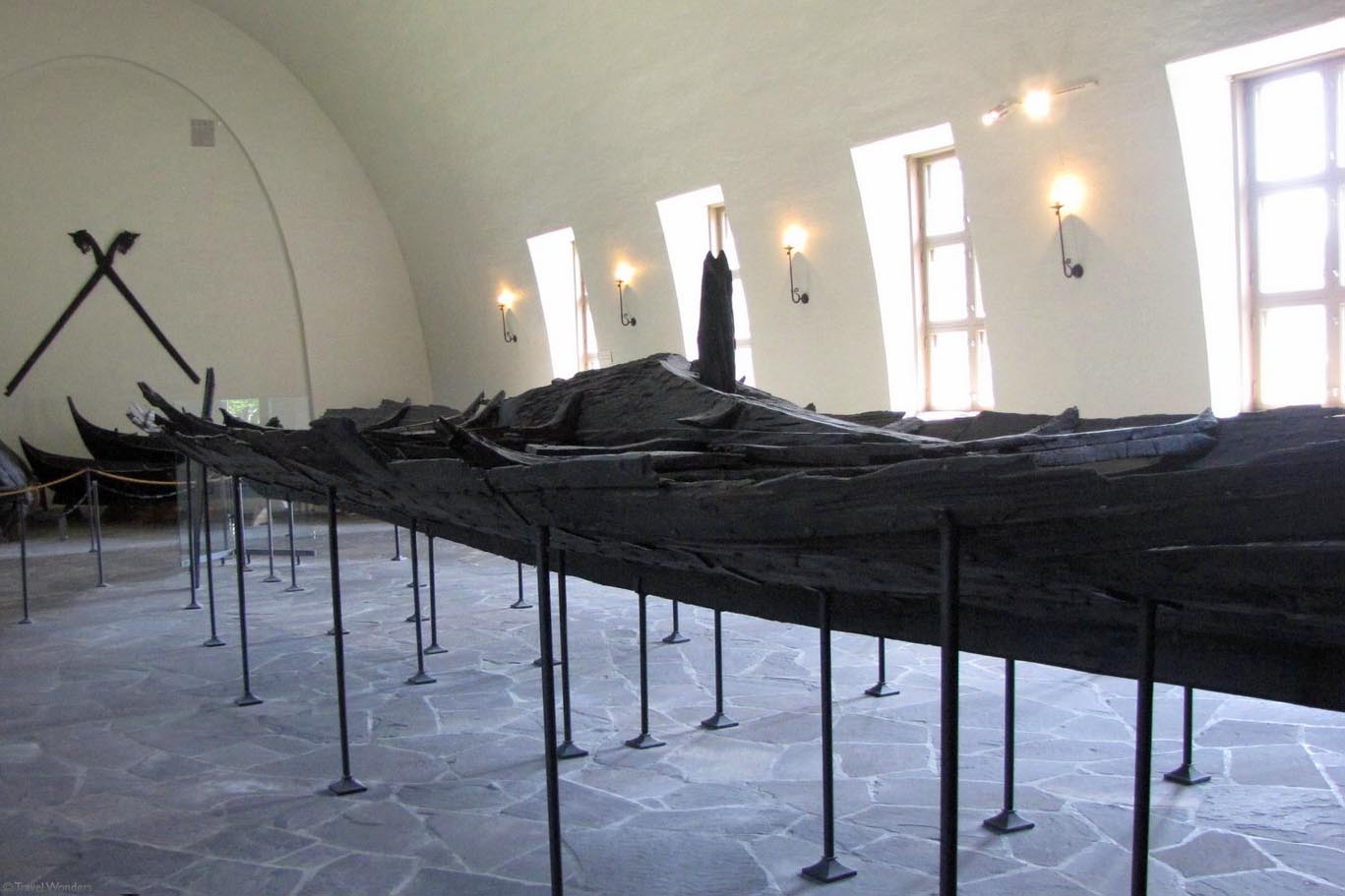
Three superb Viking ships are on display in the purpose-built Oslo Viking Ship Museum (Vikingskiphuset). Fortuitously discovered over 100 years ago in a remarkable embalmed state in various local clay bogs that acted as ritual burial mounds, two of the ships are near complete.


On entering the museum, the Oseberg stands majestically for all to view. Discovered as a grave in 1904, a Viking Queen was buried with the Oseberg to aid her marine passage to the next life. At 22 metres in length with fifteen pairs of rowing positions, the Oseberg was constructed in the early 800s for access to fjords and coastal waters. It is carved in magical detail with superb swirling bow and stern features and ornate patterns of Norse sagas and gods carved on its sides.


From the viewing platform, the ship’s construction can be seen with long sweeping planks of wood joined together to form the spine of the ship before cross ribs were nailed to provide the ship’s strength. The mast adds the option of sailing to that of rowing.


Sadly looted of its most valuable treasures, the burial area held two bodies along with textiles, leather shoes, tools, cooking utensils, buckets (one with a few wild apples) and wooden carvings – all made by skilled artisans and in remarkable condition after 1,200 years. These findings are especially valued as they rarely survive the ravages of over a thousand years.


Three regal carved wooden beds and the frames of two tents offer comfortable evenings for the buried queen. An intricately carved ash and oak cart designed for two horses seems strange with the lack of roads but has a well-thought design with the carriage being demountable. Along with the cart are four horse-drawn sleds also featuring ornate carvings and clever engineering to enable easy transportation in the winter months.


Turning right, the Tune ship is the smallest of the three ships and in considerable disrepair. With only part of the keel of the ship left, it shows the advanced construction in some detail but little else.


At the other end of the museum is the Gokstad. In contrast to the Oseberg, the Gokstad (built in the late 800s) is a Viking longship and far more seaworthy with its beautifully crafted broad base, high sides, hatches for the oar holes (when sailing) and strengthened keel. Less ornate and ceremonial and capable of war, the ship was discovered with 64 wooden shields for a crew as large as seventy. A copy of the Gokstad successfully sailed from Norway to the United States. While a sizable ship, every ounce of legendary Viking toughness, resourcefulness and persistence must have been needed to travel the harsh Arctic seas and conduct the long journey to North America.


Again, being a grave site, the ship was discovered with a variety of household materials, animals and harnesses for horses. The timber burial chamber and a pair of small boats are displayed in the Tune room.


The Viking Ship Museum is a superb collection of 1,200 year old relics highlighting the craftsmanship and artisanship of a highly advanced maritime civilisation. Along with the extraordinary Vigeland Sculpture Park, the museum is an Oslo highlight bringing to life the Viking way of living and a chance to revel in their complex society and admire their remarkable seamanship in a well-presented showcase.

12/23/2011

The Thrill of Jetboating (Hanmer Springs, New Zealand)

0 nhận xét
Around 90 minutes drive from the major South Island city of Christchurch, Hanmer Springs has a European alpine feel, sitting in an amphitheatre of snow-capped mountains. The town, with less than 1000 people is a popular adventure capital of New Zealand while also offering a chance to relax and escape the rigours of normal life.. While a variety of adventures abound, one of the most quintessential New Zealand adventures is jetboating, a chance to experience Hanmer's Waiai River at high speed at close quarters.

These highly manoeuvrable power boats pack in around a dozen people, shooting down narrow rapids at speeds nearing 100 kilometres per hour (similar to a car on an open highway) while skimming within inches of sharp rocky walls or stony river banks. The boats are capable of turning around within a car length and often perform 360 degree spins (called a Hamilton Spin after the inventor) sending up large sprays of water in all directions, the bracing spray sending a reminder that these are alpine waters.

Invented in New Zealand in the 1950s by Sir William Hamilton, the jetboat is purpose-designed for the fast powerful-running shallow Kiwi rivers where deluging water from large tracts of land are forced through the narrow steep-sided gorges to escape to sea. Immense engines suck water in from under the boat and expel it out the back. This design enables good speed against the rushing waters and only requires a few inches (less than 10 centimetres) of depth to operate – typical of the New Zealand rivers with their rocky bottoms and snaking paths.

On the day our group travelled, the river was running at in impressive 100 tonnes of water per second, though in flood it can reach ten times that amount. Deer and goats stand uninterested on the harsh slopes while birdlife watch on not understanding the commotion.

If still requiring further adrenalin lifts, bungy jumping (35 metres off an historic bridge), quad-biking and white-water rafting adventures also appear on the menu but for me, a relaxing hour in the natural thermal pool more fits the bill.

Wonderfully set with a mountain backdrop, fifteen open-air pools with naturally warmed and mineral waters greet visitors, as they have since 1875.

Located halfway between Christchurch and the whale-watching centre of Kaikoura, Hanmer Springs is a chance to embrace both the most adventurous and the most relaxing of Kiwi experiences.

Tears at Don Rak War Cemetery (Kanchanaburi, Thailand)

0 nhận xét
Just a short stroll from the Bridge over the River Kwai is the most moving sight of Kanchanaburi War Cemetery. The Don Rak War Cemetery is the final resting place of around 5000 Commonwealth and 2,000 Dutch prisoners of war (the Americans repatriated their war dead), literally worked to death with their military colleagues under a brutal work regime. Their plaques sit on a beautifully manicured and lovingly tendered lawn, each small bronze plaque representing the loss of a father, son, husband and/or grandson. Tiny gardens and colourful blooms interlace the cemetery lovingly tendered by the Thai people.

A few people wander the cemetery in silence reading each plaque and soaking in the ultimate sacrifice made by so many brave men.

The ages of most are so young, men barely out of boyhood living their last months in such awful conditions – it is hardly imaginable. Many feature a short inscription from parents or family which adds an individual touch and character to the valiant soldier who gave his life so we can have a better and freer life today. Each phrase stirs the heart strings. Each epitaph tells a story.

A voice we love is still.
A place vacant that we can never fill.


For your tomorrow we gave our today.

He died that we might live. Ever remembered.

Some day “Tom” I will understand.

Greater Love hath no man than this. That he lay down his life.

It is estimated that one person died for each railway sleeper laid on the Death Railway.

The entrance contains a small altar with a variety of plaques and memorials. At the rear of the cemetery is a plot that carries the ashes of 300 cholera victims from an outbreak in 1943 in the Nieke camp. A large memorial cross stands like a beacon of hope in the centre of the cemetery.

Unlike the famed bridge, Don Rak captures the emotion and feeling of this area. My tears fell as I sat quietly under the tree trying to truly understand what this place means. I cried for the thousands of young men who gave up their lives so my life can be better and that our lives can be lived in freedom.

Every ANZAC Day (25 April) a small ceremony is conducted at Don Rak as it is in many cemeteries and memorials around the world and in towns, big and small, all over Australia and New Zealand. The Ode of Remembrance is read as we recall the brave people at places like Don Rak in their harrowing experiences in building this railway.

12/12/2011

The Beauty and Terror of Loch Ard Gorge (Australia)

0 nhận xét

In sunshine, the Victorian coastline known as the Great Ocean Road offers panoramas of glistening blue ocean, natural beauty and a sense of serenity. The area is dotted with unusual and striking rock formations (several with evocative names like the Twelve Apostles, London Bridge and The Grotto) gradually being warn by the savage seas. When the weather is nasty, the ocean turns to a inky swirling maelstrom and the wind whistles in evil howls. For mariners, such weather must be hellish.

As such, the area is also known as Shipwreck Coast with over 700 ships recorded as lost through Australia's short history (less than a third have been located).

Days of thick fogs, grey skies, blustery winds and rough seas prevented the captain of the Loch Ard, an iron-hulled clipper sailing from England from completing his journey. Trying to navigate the brutal strait (threading the needle) between King Island and the mainland in the early winter of 1878, the Loch Ard plunged into a tiny rocky island just off the mainland called Muttonbird Island. Within fifteen short minutes, the ship sunk taking the lives of 52 of its passengers.

Miraculously, Tom Pearce, a young man of 18 clung to a lifeboat and was fortuitously swept through the narrow opening of Loch Ard Gorge onto a tiny peaceful beach. Hearing screams and spotting a young woman struggling in the waves clinging desperately to flotsam, Tom swam and rescued the only other survivor, the by-then unconscious Eva Carmichael. Revived by brandy from a washed up crate, both rested in a cave protected by a tiny strip of beach and surrounded by the suffocating cliffs of the gorge. After some rest, Tom climbed the steep cliffs (now a set of wooden stairs) to seek help and both were rescued. Neither saw each other ever after the rescue period, Eva returning to Ireland (Tom became a ship's captain!).

Today, visitors can quietly stroll the beach, visit the small cave, gaze at the vertical walls of the cliff and walk the pleasant trails around Loch Ard Gorge highlighting the peaceful triangle of water and the hidden gate to the Antarctic Ocean and open seas.

Nearby, people can see a living reminder of the unrelenting seas chipping away at the fragile limestone coast. Island Arch stood guard near Loch Ard Gorge for many centuries until in July, 2009 it collapsed leaving two pillars. These have been named Tom and Eva in memory of the two brave survivors of the area's most well-known shipwreck.

Similarly recent collapses lays witness to the continuing weathering and change in the area. Another of the Twelve Apostles toppled some years ago and London Bridge became London Arch in 1990.

For parts of this beautiful area, the road hugs the water as vistas of the rugged coastline open around each sweeping bend. Many rate it Australia's finest drive. Numerous stops and sidepaths highlight various rock formations and panoramic lookouts. Loch Ard Gorge is a highlight stop giving a glimpse into the feeling of desperation that young Tom and Eva, along with the passengers and crew of the Loch Ard must have felt as brutal weather, poor visibility and the savage coastline played in taking the lives of 52 people and how luck played such a part in saving two souls.

12/04/2011

Vigeland Sculpture Park: A Study of Humanity (Oslo, Norway)

0 nhận xét
As a sculptor, Gustav Vigeland struck an interesting deal with Oslo. They bought him a spacious and comfortable studio in a central park and Vigeland donated all his created artworks to the city. Over twenty years Vigeland carved over 200 statues involving many hundreds of human figures - both men and women of all ages in various emotional states and pursuits (running, sitting, jumping, gathering together, hugging and fighting) and all without a stitch of clothing.

In today’s shrill world, prudish countries would be up in arms and censors and do-gooders tripping over themselves trying to ban the artworks and decrying the polluting of everyone’s minds. However, Oslo's Vigeland Sculpture Park(as part of the huge Frogner Park complex) provides an oasis of tranquillity and a peaceful ambiance of awe-inspiring sculpture. People wander quietly admiring the skill of the works, pointing subtle details in individual characters – each their own character and lifeform.

A central path follows the main highlights of Vigeland’s work starting from the striking bronze gates topped with old style lanterns. The Bridge crosses a small lake and is flanked by numerous lifesized figures both single and grouped, giving the first look at the detail of the works. The granite is incredibly smooth.

Even in close-up, the human detail comes to life. The facial expressions, the angle of the hands and the general pose all revealing the mood and personality of the individual statues. The most famous statue called The Angry Boy (sinnataggen) is on the bridge, rubbed to a glossy finish by decades of admirers, though I struggle to see why this statue stands out above others.

Capturing the human spirit through the cycle of life, the Fountain shows man's journey from cradle to grave. All male, it shows the eternal cycle of life from childhood through adulthood to old age and death, captured under gushing water. Just past the fountain is my favourite statue at the high point of the park – the Monolith (top photo). Intertwined up a 15 metre statue are a chaotic emotional tangle of lean and naked humanity all remarkably carved from a single piece of granite. While some figures rest peacefully in this tower of twisted torsos, others appear to be clambering towards the top of the obelisk in an internal battle for supremacy.

Past a sundial, the final statue is The Wheel of Life (lijshjulet) showing a circular bronze monument of men, women and children, another statement on Vigeland’s constant theme of the cycle of life.

Beyond the superb carving, it is Vigeland’s ability to capture the full range of human expressions covering sadness, anger, joy and laughter across the hundred of sculptures that makes the displays so mesmerising.

Initially the artist’s home and art studio, the neighbouring Vigeland Museum contains numerous partial sculptures, photographs, plaster works and sketches related to his final vision and creation. It brings the artist himself to life and is well worth the slight detour after wandering the park.

The statues were first cast in clay (all by Vigeland) before three sculptors translated the works into granite and bronze over a fourteen year period. The initial display must have stunned the local population with its scale, variety and enshrining of human life.

On a visit to Oslo, Vigeland Park is a highlight among Oslo’s natural surrounds, museums and castles well worthy of a couple of hours of cultured and contemplative roaming among the greenery and Gustav Vigeland’s remarkable artistic commentary on human life.


11/29/2011

The Trolls Way (Geiranger, Norway)

0 nhận xét
Everytime I think of the travel wonder of Trollstigen (the Troll’s Ladder), one of Norway’s and Europe’s finest drives, I am reminded of a great story told to me as a child.

It is the story of Three Billy Goats Gruff, a fable told to children around the world (but especially Scandinavia) for over a century. In this tale, there are three goats who have run out of grass in their field and to get to more grass, they need to cross a bridge guarded by a nasty old troll (a stout Norse mythology creature with an oversized nose) who likes to eat goats. The first goat is challenged and explains that his older brother is coming and the troll let him pass with the promise of a larger meal. The second goat wanders across the bridge and again explains that his eldest brother is following closely behind and is allowed to pass. The eldest goat crosses the bridge and as the troll goes to eat him, he is gored to death, leaving the bridge safe for all times.

Trollstigen is a snaking single lane road carved out of the mountainous path between Ǻndalsnes and the extraordinarily beautiful Geirangerfjord in central Norway – an aquamarine highway of water sandwiched between towering granite walls that stand tall even among the stunningly exceptional fjords which pockmark the west coast of Norway.

The road is engulfed by a chessboard of mountains with evocative names like The King, The Queen and The Bishop. The pounding waterfall of Stigfossen finds a more direct way down the mountain cutting under the road in a few places, falling into a gushing dark stream where it is easy to believe that trolls have stealthily inhabited for centuries. Even road signs warn motorists (and cyclists – apparently trolls like cyclists) of troll crossings.


Having survived the climb of Trollstigen, its eleven hairpin turns and avoiding being on the troll’s morning tea menu, you are rewarded with a superb vista of Geirangerfjord. A ferry ride and a drive down the Eagles Road (Ørneveien) past some turf-roofed farms of yesteryear and you arrive at the delightful village of Geiranger and its extraordinary waterway.

Tourist boats ply these waters regularly in the warmer months. The steep walls of the fjord are punctuated by towering waterfalls several hundred metres in height. The two most notable falls are the lead players in another Norse tale. The elegant Seven Sisters is being wooed by a matching fall on the other side appropriately called The Suitor (these Norwegians have rich imaginations!).

Strangely on this most treasured drive, I am sure I spotted a few trolls in the distance but I didn’t see a single goat. Maybe the trolls still manage the Trollstigen crossings.


11/08/2011

Thermal Wonderland (Rotorua, New Zealand)

0 nhận xét
Australians have always felt a close affinity with our New Zealand cousins. As a travel destination, New Zealand is one of the world’s most inviting destinations – dominated by extraordinary scenery of glorious mountain ranges, untouched forests, stellar national parks and sparkling oceans and complemented with a vibrant and deeply respected Maori culture (a lesson for the world) and an easy-going, unrushed population.

While Christchurch has started to rebuild from a devastating earthquake that caused untold damage, took over 150 lives and shredded the fundamental infrastructure of the city, travellers assumed that all of New Zealand was a disaster zone and closed down. Nothing could be further from the truth. An initiative of a group of Kiwi travel bloggers under the banner of Blog4NZ (twitter: #blog4nz) have encouraged over 100 bloggers worldwide to publish favourite stories of this vibrant country to encourage the world to visit. Tourism comprises around 10% of the New Zealand economy and so each visitor can help in a small way to help rebuild the South Island’s largest city and the impact on the country in general. Note that the Christchurch Airport continues to operate normally and is the perfect gateway to the South Island and its incredible natural beauty.

This article describes the unusual thermal region of Rotorua (visited in September, 2010) but readers can find other New Zealand stories on the Waitomo Glowworm Caves, the steepest street in the world and the thunderous Huka Falls.


The odorous rotten-egg gas hits me first. Within a few miles of Rotorua, the rich sulphurous air gives a taste of a remarkable landscape. Revered by the Maoris, the highlight of the area is Te Whakarewarewa which everyone confidently and loudly calls fa-ka (wh is pronounced f in Maori).

Presented almost as a mini-New Zealand, the area’s highlights are undoubtedly the spurting geysers, bubbling mud pools and steaming springs. Just past the symbolic entrance of raised wooden poles is the Kiwi House. New Zealand’s iconic bird forages in the semi-darkness, its plump body, matted feathers and strange long beak difficult to spot in the nocturnal conditions that Kiwis prefer. Sadly, there is little chance of seeing them in the wild so this is the best way to see this endangered fellow. Mating for life, the male Kiwi incubates the egg in one of nature’s more evenly shared breeding partnerships.

From the Kiwi House, the inhospitable primeval landscape lays in front of my eyes. Geysers spurt and steam billows erratically from several spots rebelling against the chilly wintry air. Several pools of mud on permanent simmer bubble, gurgle and froth under a veil of steam, belching their foul-smelling gases into the air like the worst of house guests.

Most of the geysers spurt from a multi-coloured lunar-like area called Geyser Flat. In a kind of thermal warm-up act, the grandly named Prince of Feathers geyser spurts before launching the most impressive Pohutu Geyser. Super-heated by molten rock under increasing pressure as steam builds underground, the boiling rainwater spurts many meters into the air with an impressive blast, before commencing the cycle over again. The active landscape is a reminder that geologically, New Zealand is one of the world’s youngest countries.

Strange holes seemingly lead to Middle Earth, the grey fringes giving a sense of foreboding about whether a geyser is about to shoot. Various activities utilising warming bore water for spas in the Rotorua area resulted in some geysers in the area stopping.

As an indicator of Maori reverence for this site, a Maori cemetery overlooks the main geyser area, plain white headstones and carved wooden statues marking the buried ancestors. Homage is appropriately paid to the Maori God of Fire.

Nearby, a permanently boiling water hole was used for centuries by the Maoris as a cooking area and currently highlights the innovative cooking methods with woven baskets making ideal “pots” for dunking the eggs and vegetables.A boiled egg with such little fuss.

The remainder of the site is a Maori cultural centre. With an area of pre-European Maori housing, a more modern marae or Maori meeting house and national schools for the Maori arts of weaving and carving, the Maori culture is well enshrined ensuring that their heritage and practices are not lost in modern society.

In the Maori weaving school, small clumps of the strands of the flax plant are expertly rolled across the leg forming long strings that are dyed and woven into clothing, baskets and other goods. Feathers and skins are often added for warmth or ceremonial appeal.

Around the area, I can strongly recommend completing a Rotorua day with a visit to one of several thermal pools (lose the silver jewellery first unless you want them all tarnished) for an incredibly therapeutic and relaxing experience.

Despite the odours, New Zealand's Sulphur City is a great place to visit, with the popular Whaka offering a chance to liven all the senses with the Earth's natural power in its rawest form across a thermal wonderland of geysers, boiling mud and venting steam. And to add the Kiwi flavour, a chance to experience two of the country's most identifiable images - to peer through the murkiness to witness a Kiwi scratching amongst the undergrowth and to watch a thriving Maori culture that harnesses the thermal area so harmoniously.

Roman History in Croatia (Pula, Croatia)

0 nhận xét
Not many cities can boast a Roman amphitheatre in the centre of town. Pula is strategically perched at the bottom of the Istrian peninsula in the west of Croatia and is dotted with several monuments from the Roman era. It isn’t difficult to imagine toga-clad men walking the streets and gathering in the main forum in a city whose layout appears unchanged for two millennia.

Several Roman gates all built around 2000 years ago lead to a city with a number of cobbled streets highlighting a rich history of Roman, Byzantine, Venetian and Austrian occupation. With their remarkable engineering and architecture it is little wonder that there is more evidence of the Romans than any other, including a temple, mosaics and an old theatre. The oldest Roman city entrance is the elegant Gate of Hercules (with surrounding town walls built later) with the badly eroded carving of Hercules and his club at the top of the arch and the names of the two Roman officials (one was the brother of Cassius who killed Julius Caesar) who led the building of the city.

The main square was once the Roman Forum and boasts the harmonious columned Temple of Romae and Augustus. Around 2000 years old, I wonder how many of today’s building will be viewed in the same majesty 2000 years from now. Mind you, this one didn’t survive a bomb late in World War II and was carefully recreated after the war.

However the undoubted highlight of Pula is the Arena, a large Roman amphitheatre that held over 25000 spectators in its day and continues to see concerts and performances today though only with audiences of 5000 (varying from Pavarotti to Elton John). Engagingly lit at night and the same age as its famous cousin in central Rome, it was sadly denuded internally over the centuries (the seats and some of the underground areas) to supply building material for other projects by the Venetians (including the four-pointed star shaped castle which provides the best external view of the Arena and now hosts the Istrian History Museum). At one point, the Venetians considered dismantling the whole amphitheatre and re-erecting it in Venice, but Pula eventually got to maintain its treasured attraction.

The Arenadesign is impressive with the stadium being three levels on the side facing the sea and two levels on the other side to account for a marked incline in the land.

The underground areas have been replaced but with a fairly thoughtless and careless cement and concrete approach. However, it does give a good sense as to the complex arrangement of managing the various wild animals, sets and gladiators that provided entertainment for a lusting audience.

In the spirit of remarkable engineering, structures at the top of the 30 metre well-preserved walls of the amphitheatre show that the complex could be fitted with awnings for hot or wet weather and the towers contained water tanks to provide fountains during the shows (the Romans think of everything!!).

Croatian pride in their Roman treasure includes featuring it on the ten Kuna note (around US$2) though the mint uses artist’s discretion to remove the various scaffolds and repair areas that mar photographers’ efforts!!http://www.blogger.com/img/blank.gif

Pula provides an excellent day wandering the Roman monuments that dot the city and provides an excellent base for exploring the Istrian hill towns, including such travel wonders as Matovun, Buzet, Labin and Hum (the smallest city in the world). Make sure that you grab a copy of the Arena audio tour to discover the innovative building and design methods used in constructing this superb entertainment centre of over two thousand years of age.