


The mere mention of the word viking conjures images of wild unruly men in horned helmets sailing the seas in magnificent wooden sailing ships and raiding, plundering and pillaging lands across Europe. While science has since shown that Vikings were more civilised than their reputation and didn’t wear horned helmets, they were undoubtedly master ship builders and mariners.
Three superb Viking ships are on display in the purpose-built Oslo Viking Ship Museum (Vikingskiphuset). Fortuitously discovered over 100 years ago in a remarkable embalmed state in various local clay bogs that acted as ritual burial mounds, two of the ships are near complete.
 On entering the museum, the Oseberg stands majestically for all to view. Discovered as a grave in 1904, a Viking Queen was buried with the Oseberg to aid her marine passage to the next life. At 22 metres in length with fifteen pairs of rowing positions, the Oseberg was constructed in the early 800s for access to fjords and coastal waters. It is carved in magical detail with superb swirling bow and stern features and ornate patterns of Norse sagas and gods carved on its sides.
 From the viewing platform, the ship’s construction can be seen with long sweeping planks of wood joined together to form the spine of the ship before cross ribs were nailed to provide the ship’s strength. The mast adds the option of sailing to that of rowing.
Sadly looted of its most valuable treasures, the burial area held two bodies along with textiles, leather shoes, tools, cooking utensils, buckets (one with a few wild apples) and wooden carvings – all made by skilled artisans and in remarkable condition after 1,200 years. These findings are especially valued as they rarely survive the ravages of over a thousand years.
 Three regal carved wooden beds and the frames of two tents offer comfortable evenings for the buried queen. An intricately carved ash and oak cart designed for two horses seems strange with the lack of roads but has a well-thought design with the carriage being demountable. Along with the cart are four horse-drawn sleds also featuring ornate carvings and clever engineering to enable easy transportation in the winter months.
 Turning right, the Tune ship is the smallest of the three ships and in considerable disrepair. With only part of the keel of the ship left, it shows the advanced construction in some detail but little else.
 At the other end of the museum is the Gokstad. In contrast to the Oseberg, the Gokstad (built in the late 800s) is a Viking longship and far more seaworthy with its beautifully crafted broad base, high sides, hatches for the oar holes (when sailing) and strengthened keel. Less ornate and ceremonial and capable of war, the ship was discovered with 64 wooden shields for a crew as large as seventy. A copy of the Gokstad successfully sailed from Norway to the United States. While a sizable ship, every ounce of legendary Viking toughness, resourcefulness and persistence must have been needed to travel the harsh Arctic seas and conduct the long journey to North America.
 Again, being a grave site, the ship was discovered with a variety of household materials, animals and harnesses for horses. The timber burial chamber and a pair of small boats are displayed in the Tune room.
The Viking Ship Museum is a superb collection of 1,200 year old relics highlighting the craftsmanship and artisanship of a highly advanced maritime civilisation. Along with the extraordinary Vigeland Sculpture Park, the museum is an Oslo highlight bringing to life the Viking way of living and a chance to revel in their complex society and admire their remarkable seamanship in a well-presented showcase.
Three superb Viking ships are on display in the purpose-built Oslo Viking Ship Museum (Vikingskiphuset). Fortuitously discovered over 100 years ago in a remarkable embalmed state in various local clay bogs that acted as ritual burial mounds, two of the ships are near complete.
 On entering the museum, the Oseberg stands majestically for all to view. Discovered as a grave in 1904, a Viking Queen was buried with the Oseberg to aid her marine passage to the next life. At 22 metres in length with fifteen pairs of rowing positions, the Oseberg was constructed in the early 800s for access to fjords and coastal waters. It is carved in magical detail with superb swirling bow and stern features and ornate patterns of Norse sagas and gods carved on its sides.
 From the viewing platform, the ship’s construction can be seen with long sweeping planks of wood joined together to form the spine of the ship before cross ribs were nailed to provide the ship’s strength. The mast adds the option of sailing to that of rowing.
Sadly looted of its most valuable treasures, the burial area held two bodies along with textiles, leather shoes, tools, cooking utensils, buckets (one with a few wild apples) and wooden carvings – all made by skilled artisans and in remarkable condition after 1,200 years. These findings are especially valued as they rarely survive the ravages of over a thousand years.
 Three regal carved wooden beds and the frames of two tents offer comfortable evenings for the buried queen. An intricately carved ash and oak cart designed for two horses seems strange with the lack of roads but has a well-thought design with the carriage being demountable. Along with the cart are four horse-drawn sleds also featuring ornate carvings and clever engineering to enable easy transportation in the winter months.
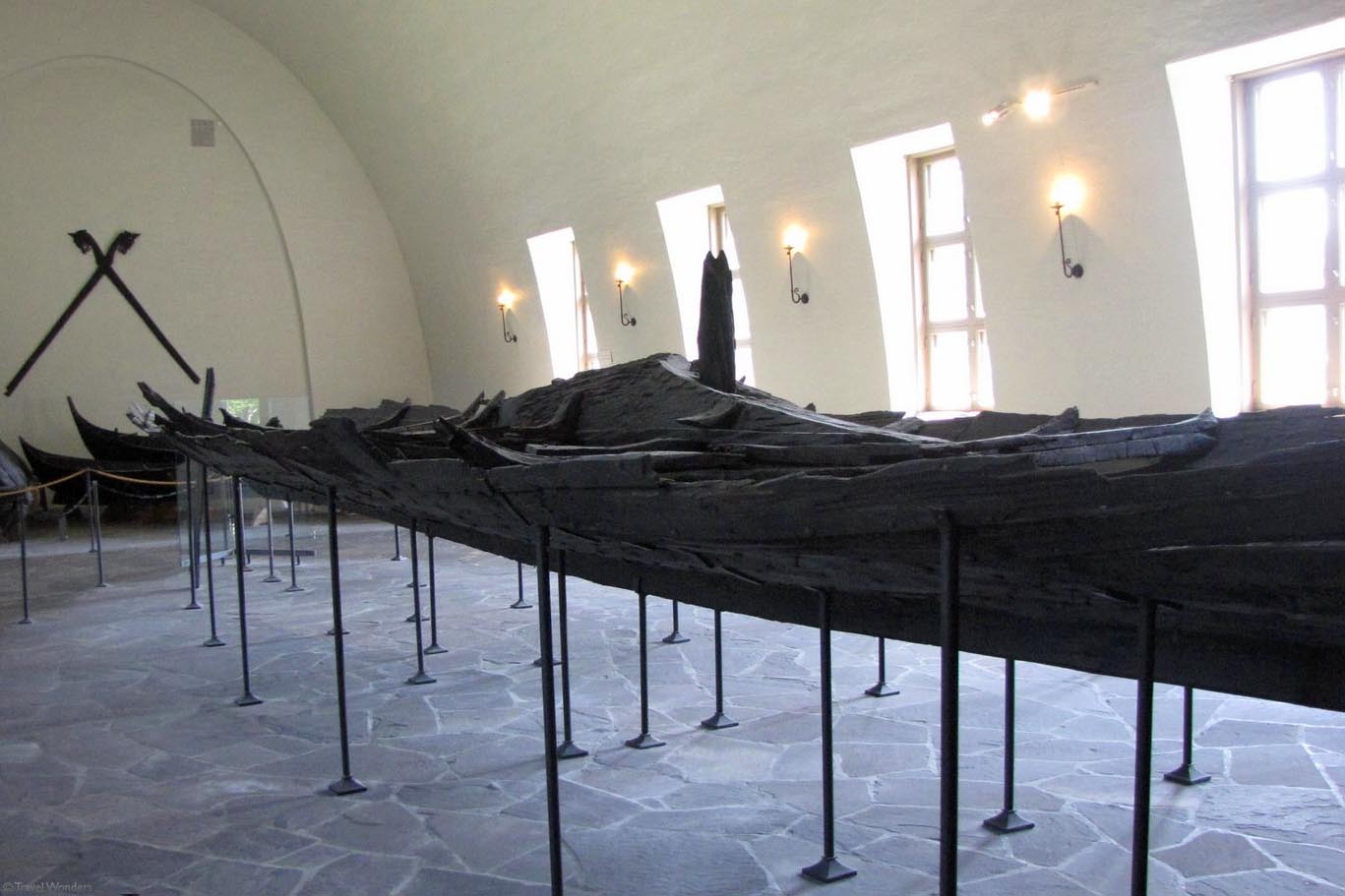 Turning right, the Tune ship is the smallest of the three ships and in considerable disrepair. With only part of the keel of the ship left, it shows the advanced construction in some detail but little else.
 At the other end of the museum is the Gokstad. In contrast to the Oseberg, the Gokstad (built in the late 800s) is a Viking longship and far more seaworthy with its beautifully crafted broad base, high sides, hatches for the oar holes (when sailing) and strengthened keel. Less ornate and ceremonial and capable of war, the ship was discovered with 64 wooden shields for a crew as large as seventy. A copy of the Gokstad successfully sailed from Norway to the United States. While a sizable ship, every ounce of legendary Viking toughness, resourcefulness and persistence must have been needed to travel the harsh Arctic seas and conduct the long journey to North America.
 Again, being a grave site, the ship was discovered with a variety of household materials, animals and harnesses for horses. The timber burial chamber and a pair of small boats are displayed in the Tune room.
The Viking Ship Museum is a superb collection of 1,200 year old relics highlighting the craftsmanship and artisanship of a highly advanced maritime civilisation. Along with the extraordinary Vigeland Sculpture Park, the museum is an Oslo highlight bringing to life the Viking way of living and a chance to revel in their complex society and admire their remarkable seamanship in a well-presented showcase.


